Posts in business & career
Read For New Business

One of the biggest challenges for any consultant is business development. I would be lying if I said my business was booming - always. I’ve written about the big business lie we tell one another before. Business isn’t always great sometimes it’s actually terrible. 

I recently picked up a copy of How Clients Buy: A Practical Guide to Business Development for Consulting and Professional Services by Tom McMakin and Doug Fletcher. I literally found the book on the shelf at the airport and purchased a copy. I usually buy books or get sent books that come recommended to me but the title resonated with me, so I coughed up some cash and dug right in.

The following are my key takeaways directly from How Clients Buy:

It’s crucial that we recognize the seven elements of how clients buy. They have to be aware of your existence. They come to understand what you do and how you’re unique. They develop an interest. They respect your work and are filled with confidence that you can help them. They trust you. They have the ability to pull the trigger. They are ready to do something.


In professional services, we are the product. The biggest challenge in our path to become rainmakers is to unlearn what we think we already know. 

If you want to be remembered, you must find a category where you can be number one. You have to know who you want to serve. Identify the type of company but also the role inside the company who you help. When selling consulting or professional services, the goal is not to identify prospects and process them like corn flakes; it is to identify a community and position ourselves to serve it over time. Prospective clients cannot engage with us unless they know us. Niche yourself and then re-niche yourself over time. 

Create a point of differentiation. When there’s a really clear association in your mind between a person that you trust and the problem that they can solve, it makes it easier to refer you.

Great client relationships are built over time on foundations of trust and are not, by definition, transactional. Respect trumps charm when it comes to most buying decisions for consulting and professional services. Instead of focusing on like in “know, like and trust” focus on respect. They have to know, respect and trust you. 

Clients have to conclude that: What you do is relevant to them and their goals. You have to solve a problem, support a strategic initiative, or promote an organizational agenda that is on their plate. The goal is to be a problem solver. If you can tell them a solution before they recognize they have a problem they need, you are best positioned to win the business.

New business comes from three places: repeat, recommendations, new clients with no relationship. Always start with your current or past clients.

A high-return opportunity with very low risk will attract attention. Dedicate time every day to building genuine relationships with clients and prospective clients. Never underestimate the value of networking and the value of your network. 

The secret to business development is to ask lots of questions. Start from a place of empathy. No one ever needs a consultant until they do.

There are many actionable ideas you will learn in How Clients Buy. I highly recommend you pick up a copy now and dig right in.

Photo by Ben White on Unsplash

Waves
Waves in entrepreneurship

Picture deep, dark, waves violently bashing up and down endlessly. This is often how an entrepreneurial journey feels. The waves can be exhausting and dangerous. They can appear like there is no end in sight. 

Zoom out of the picture slowly. The color of the waves is transforming from navy blue to aquamarine. The waves are settling down now as you realize you are not looking deep into an ocean, instead, it is a wave pool at a waterpark. 

Wave Pool.jpg

These two scenarios sum up entrepreneurship. Some weeks are filled with threatening waves and others are the fun ones you can splash around in. These different waves can appear within the same hour too. Step back and realize you are in a wave pool more often than you think.

Treat entrepreneurship like a visit to a waterpark

When you research and plan the waterslides you most want to ride, you are more likely to achieve these goals. Start with a plan.

Instead of waiting and waiting, show up early to beat the crowds. There will always be other people visiting the park.

Don't judge people. Observe the terrible tattoos and realize everybody makes bad decisions.

As the day goes on, the lines grow longer. If you find yourself at the end of one, refrain from staring up in envy to those at the top. They waited just as long as you did.

Understand that you might not be able to ride every waterslide. You can return another day. In fact, if you travel a little you might discover an even better waterpark waiting for you.

Reward yourself for your hard work by grabbing a tube and floating along the lazy river. You have earned it.

The next time you feel that you are in too deep, take some steps back. Decide what you should do by analyzing the situation. Are you lost, floating in the ocean on the verge of drowning? Or are you in a wave pool? I bet you will find you are in the waterpark far more often than you think.

Make no mistake, you will get wet on this ride.

Photo from Flickr by Cristiano Palese.

12 Tips You Might Not Know About Running a Winning Business
12 tips from Andy Bailey PetraCoach

One of the first of many valuable tips in Andy Bailey's book, No Try Only Do: Building A Business On Purpose, Alignment, And Accountability is to seek guidance and advice for your business. I expect you will agree if you are a busy owner or leader of a business or department.

I recently spent some time with the author, CEO, and founder of Petra Coach. Bailey shared his story with me and gave me invaluable advice for my business, Futureforth. He also handed me a copy of his book filled with professional wisdom to help business owners.

Twelve Key Takeaways from “No Try Only Do” 

1. You must want to change. You have to know that where you are is not where you need to be for change to occur. Bailey urges his readers to “suck up your pride and get out of your own way.” It’s true that we all fall guilty of thinking we know what’s best all of the time. This simply isn’t always true, so learning from mentors and peers will help change yourself and your businesses. 

2. Create a one-page strategic plan and list your quarterly priorities. Stick this on your wall in your office. 

3. Determine what your Core Purpose for your business is. Who do you serve? What will they gain from working with you? Then add your Core Values. Begin by asking, “What is the purpose of your organization? Why does your company exist?”

4. Create a Big Hairy Audacious Goal (BHAG) and set a date in the future when you will reach that goal. Bailey uses +10Mhm in his LinkedIn profile summary and email signature. This represents his goal of having a positive impact on ten million people. His previous BHAG was +10Khm which he reached. Anything is possible.

5. Hold a daily huddle with yourself. Write down your top priorities each day and recap the previous day. Create a weekly accountability report. Review these at the end of each quarter. Consider what lessons you have learned. Where were your biggest wins and biggest failures?

6. Money is something you can either spend wastefully or use strategically to build wealth.

900903db9bb1e9f44fe2aafb374be641.jpg

7. Keep an Evernote list of people you have met whom you would call “A-Players”. These are people you wish to get to know better. Refer to this list and promote what these individuals create. Keep in touch with them.

8. Use handwritten Thank You notes. A physical note goes a long way in a digital world. 

9. Remember the value of being personable and ensuring you appreciate who you work with and who works for you.

10. To grow, you need to produce more time. Hiring interns and staff and outsourcing jobs will help you achieve this. 

11. Let go of things in order to grow

12. Create a plan and outline what you want to accomplish in a ten-year period for your business. Break that plan down to determine how you will reach each goal. Work backward to discover what it will take to make it work. 

Follow the steps above, and as the book subtitle reads, “you will build a business on purpose, alignment, and accountability.”

Photo by sydney Rae on Unsplash.
Improv Workshops for Business

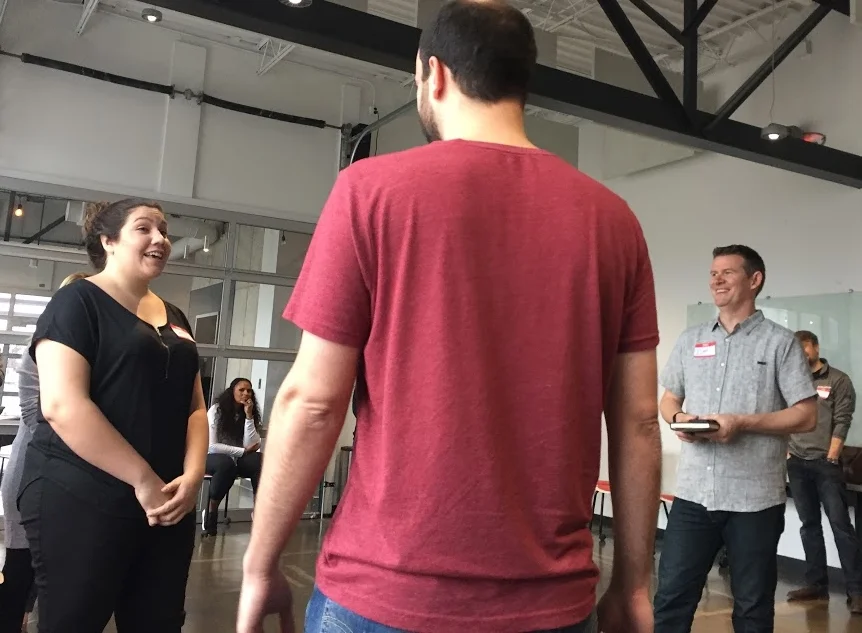
I recently conducted one of my Communication Mastery improv workshops for a technology company. The business had specific goals to use the workshop to help build stronger employee relationships and to work together better.

I developed my workshops focusing on using improv to improve workplace culture and communication. The idea to take a group of co-workers out of the office and away from their computers to play physical games can sound wild, but hear me out, because the results are astounding.

Try these improv exercises with your team

The skills and lessons learned from improv are vast and essential to anyone dealing with other people in their lives - so everyone.

Count to 20

One exercise involves standing the group in a circle. With their eyes closed and heads down they are tasked with counting to 20. Sounds easy? Not quite, because each person who calls the next number randomly chooses to do it.

With eyes closed and nobody saying "one," the exercise can't proceed. Someone needs to muster up the courage to call the first number. Then someone else must call the next number and so on. The kicker is the number resets to one each time two people call the same number at once.

This exercise is a fun warm up. It teaches participants to work together as a team, to listen intently, and to be leaders by being courageous enough to call the next number. They must work together to get to 20 to succeed.

Improv is filled with these types of lessons. Teams become stronger by working together on different exercises customized to help them achieve their goals. I always poll my clients ahead of time, so I know their challenges and can customize my program to meet their goals.

The New Boss

One of my favorite activities is New Boss. Participants run through some warm-ups where they learn to speak together as one person. Two people are paired up to become a single person, the "new boss." Everyone else is an employee who can ask random questions. The new boss must mouth and speak their answers slowly and in stereo in order to sound coherent.

This exercise teaches listening skills because they must listen to the sounds of the words as they are spoken. They also have to learn to accept the other person's choice, because one single person may not be able to answer the question as they would have otherwise wanted to.

Improv teaches us to listen more effectively, to be team players, to be empathetic and accepting of our colleagues. It also allows us to have fun together. The laughter is my greatest reward as I teach teams how to improve communication with each other and externally.

Try improv games with your colleagues. I am certain your teams will learn new skills, improve the ones they already have, and ultimately have fun doing it. Here’s a quick look at some feedback I’ve received from my workshops.

Ramble on Success
A ramble about success

I think I'm wiser from every failure. Every diet I've tried, every attempt at mindfulness and meditation, every new habit that has failed. I am too hard on myself each time I quit or fail.

I'm not unhealthy. I'm not stressed to the point of sleeplessness or suicidal thoughts. I can relax, I can breathe deeply, I can organize my day and stick with each task until completion.

I've learned these things from my sometimes feeble attempts. I understand what's needed to accomplish items when I aim to, I simply choose not too.

I choose not to stretch multiple times a day. I choose not to exercise. I choose not to work on the proposal, or plan, or manuscript. It's not you, it's me. My own worst enemy, they say.

I'm learning each day I procrastinate. I learn because I read the articles and books, I listen to the experts telling me what I must do to succeed.

Luck & Chance

We don't get their full, truthful transparency. We get the vision of excellence designed by the experts' marketing and publicity teams. We don't see their actual successes that actually fund their journey into expertise. Or maybe we do, but that's not the sexy part of the story. We don't hear about the luck and chance that got them to where they are today. Because so much is about this - luck and chance.

I can't rely exclusively on luck and chance though. Nobody should. But making attempts to improve myself gets me closer to the luck, closer to that chance encounter. Trying and failing gets me closer to the success I long for. And that success isn't the Ferrari or fancy home. It's extended vacations with my family. It's the peace of mind that the house has been paid for. It's knowing that the kids can go to college without the massive debt they should otherwise expect. It's having Heather home with me and traveling to my speaking engagements. It's knowing that our retirement savings are secure and ready for us to unplug from the day-to-day. A house on a lake with a wood-burning fireplace. Maybe a hot tub too. 

What is Success?

Having these visions alone is a success. Most people don't envision what their success looks like. Waiting in the car, in the fall sun, writing this as I wait for the kids is success. Happy, healthy, smart, silly kids... our success. Excited to see Heather when she gets home from work. Success. Leaving to Chicago for Google, success. Leaving to Louisville for my own engagement, success. Running my own business with wonderful clients, success. Writing and having my book published, success. 

Take a minute to consider what your success looks like. Now consider all of your successes to date. You're more successful than you think.

I'm 45. I'm just getting started. 

Improv Will Help Your Company
Business+improv+for+tech+companies.jpeg

Picture a six-year-old boy standing on a stage in front of an audience. The school production is of Little Red Riding Hood. The little boy stands erect, his arms spread out on each side, facing stage left and stage right. He's wearing Buster Brown shoes, brown corduroy slacks, and a forest green colored turtleneck shirt.

At an earlier date, the boy was to play the woodsman, who would rescue Little Red Riding Hood in her moment of wolf-related terror. He had trouble paying attention in class and was considered the class clown. One too many antics led to his demotion from playing the courageous hero to becoming a background actor as a boring, old tree.

His direction was simple. The replacement woodsman would act as he was chopping the tree (played by the boy) when suddenly he would hear Little Red Riding Hood's screams for help. He would take one final swing of his ax into the tree, and run off stage to her rescue. The tree, would simple tilt to the left as if slightly cut from the ax. The lights would go to black and the scene would end. That was the only action the boy would have in the play.

The proud parents in the audience were enjoying the children in the performance that evening. Everything was going as planned until the scene with the tree and the woodsman. When the woodsman heard Red's cries for help, he swung his ax one final time, only something unexpected happened. The tree tilted forward instead of to its side. The boy, standing erect, fell forward to land flat on his chest in the center of the stage. He probably yelled, "Timber!" in his mind as he slammed down onto the stage. The audience roared together in a moment of absolute hysterical laughter. The only face in the audience not laughing was the angry teacher, who directed the performance. Her punishment of the class clown had backfired. The boy's improvised fallen tree scene stole the show.

That boy was me.

I have always had a love for comedy and performance. This is why I bring humor into my presentations and workshops. I've seen presentations on similar topics that I speak on which lacked humor and ended up being dry and dull. I always aim to get the audience laughing as I present, so we all have fun together.

Improving with Improv

Performing improv

Back when I lived in Toronto, I studied and graduated from The Second City's improv training program. If you're not familiar with improv, picture the TV show, "Whose Line Is It Anyway?"

I went on to perform improv in Canada, England, Scotland, and Ireland. In fact, when I lived in Galway, Ireland, I founded an improv troupe. We performed every Thursday night at a local wine bar, and I also provided corporate improv training.

When Hubspot hired me to speak at their Inbound Conference a couple of years ago, I decided to create a new presentation entitled, "Improve with Improv". I've included the twelve-minute video below for your viewing pleasure. I wanted to share how I apply some of the key lessons from improv to my everyday life, so that others can too.

After Inbound, I was craving to perform improv again. So, I auditioned to join the Nashville Improv Company. To my happy surprise (and Heather's shock), I was accepted as a cast member! For the last year, I've been performing improv every month or so. It's been wonderful to tap back into a deep passion of mine.

My consultancy, Futureforth, is all about helping others learn how to use digital marketing for their businesses. What I didn't really consider until recently was the fact that what I do is all about communication. In fact, I did the famous Strengths Finder personality assessment and discovered my top strength is - communication (followed by consistency, woo, activator and harmony).

Being a solopreneur means working alone most days - not by choice, it's just how it is. My favorite moments are spent with my clients and audiences in-person. This got me thinking about how I could offer something new to help my clients improve their communication.

Light bulb moment. Improv!

There are countless articles about how improv training can help companies improve their communication, employee morale and retention, culture, listening and presentation skills, plus… it's a heck of a lot of fun to spend half a day (or a full day) away from your computer and playing with your colleagues.

If you want to improve your business, I have no doubt that improv will help. I want to prove this to you by coming to your office and providing your team with a fun-filled morning or afternoon of improv exercises. 

I'm calling this my Communication Reboot. Let's talk about how I can help you use improv to improve your business today. Hit contact and let's chat.

Setting and Achieving Your Goals with Overlap
How to set goals

Imagine yourself in a car at night, driving down a long, barren road with flat empty fields along both sides. You have been driving for many hours, and you have no idea where you are headed, or if you will ever reach your destination. You don't know this because you never decided where you are going. You are just driving with no plan.

You might be enjoying the feeling you get from the freedom of the open road. However, eventually, you will begin to get frustrated and feel stressed by the uncertainty of not knowing where you are going.

Setting yourself personal and professional goals will help you set and reach your destination. If you have no goals you will eventually run out of gas along the side of that barren road.

Don't quit your day job.

I was reminded of the importance of goals as I read Sean McCabe's new book, Overlap: The Ultimate Guide to Turning Your Side Passion Into a Successful Business. McCabe is an entrepreneur who has had several successful businesses over his career. We met in-person at Jeff Goins' Tribe Conference recently and spoke more about his book. He wrote it to encourage readers to go after what they truly want to do professionally. He doesn't preach what others do about quitting your day job. Instead, he encourages you to carve out time to work on a side business that can bring you joy and reward you financially. This all begins and ends with the goals you set for yourself.

In Overlap, McCabe describes his own goal of writing the book and how he completed it in just one month. He describes his process of writing 80,000 words over two weeks. McCabe includes a clever strategy to help readers set and reach their goals.

A strategy to achieve your goals.

Begin by creating a long list of all of your life goals. McCabe recommends determining which of the goals on your list will have the biggest impact on your life if accomplished in one year. He then says to start a new list and write that one goal on the top of the page. Follow this with twenty bulleted items that will get you to accomplish that goal. Dedicate one day for each item and repeat this for twenty days. 

I would add that you might need some extra time on some of the items, but you will be surprised how little time it actually takes to complete them when you write them down. It also helps to reconsider watching YouTube and Netflix during this period because focus is key.

McCabe writes, "Successful people know what they want, and they invest every ounce of their energy in going after that one thing. You can achieve many great things in life, but you can achieve only one truly great thing at a time. If you try to pursue many goals at once, you will not succeed at any of them." He adds that you should visualize achieving your goal. He says to, see it, actualize it, and internalize the fact that it will happen. Never feel you have failed to reach your goal, just that you haven't achieved it yet.

Make an on-going list of what is effecting you positively and what's doing so negatively. Doing this will help you understand what is slowing you down from achieving your goal and what is helping.

Communicate your goals.

A key message in Overlap is to communicate your goal every day to everyone in your life. Make them associate you with the goal you plan to accomplish. It needs to be on their minds when they think of you. You can even add the people in your life to your list. Some will support you all the way, while others may try to talk you out of it or even speak negatively of your goal.

McCabe writes, "If the people in your life don't know what your goal is they can't help you achieve it." He goes on to remind his readers that we need to know the goals our friends have and do our best to support them as well. As I always say, networking is a two-way street.

Why not pull your imaginary car over right now? Fire up Google Maps or grab the old Rand McNally from the glove box. Choose your destination. You are far more likely to make your journey a success when you know where you want to arrive.

Leave a comment with your goal. Maybe we can help you get there.

Beware the Employment Sunk Cost Fallacy
The Worst Job Ever

I was a sucker... or I was suckered.

Heather and I were planning to get married. It was time for me to get a grown-up job. I didn't know enough about networking yet, so I applied on job websites. I spent countless hours submitting my resume and writing cover letters for entry-level marketing jobs. 

I was getting desperate when I finally got a call for an interview. The company was situated in a swanky office off Bay Street in downtown Toronto. Bay St. is similar to Wall St. in New York, picture skyscrapers and suit and ties everywhere. Not really my bag, but I wanted a decent job. 

The Worst Job I Have Ever Had

The company specialized in creating high-priced, industry-specific summits. These summits would bring together representatives from many businesses for sales and marketing workshops and presentations. Each summit would be hosted at an exotic location that would normally include views of an ocean and golf course. There was only one catch I wasn't aware of, the summits didn't exist.

On my first day of work, I was placed in a cubicle with a computer, headset, and script. Some of the days were spent researching businesses to pitch the summits to. The other part of the day was me on the phone, carefully following my script, attempting to convince the business owner that he or she shouldn't miss such a valuable opportunity. 

The bell (yes, an actual bell) rang occasionally and a co-worker's name was written on the whiteboard walls. Everyone would scream in congratulatory excitement. My first sale couldn't be far behind, but it was. In fact, my first sale never came. After a couple of weeks, I was getting desperate because the job was commission based only, which meant if I didn't make a sale, I wouldn't get a paycheck.

They promised I would earn huge commissions off each summit sold, but I needed to make a sale first. Each night, I would sheepishly arrive home empty-handed and depressed.

This type of business relies on what phycologists call the Sunk Cost Fallacy. David McRaney's definition from You Are Not So Smart nails it perfectly.

The Sunk Cost Fallacy

"The Sunk Cost Fallacy. The Misconception: You make rational decisions based on the future value of objects, investments, and experiences. The Truth: Your decisions are tainted by the emotional investments you accumulate, and the more you invest in something the harder it becomes to abandon it."

I kept showing up because I had become too invested and embarrassed to make my experience there a failure. I finally reached my wit's end when I learned the summits didn't actually exist.

They explained they would create the summit only when enough tickets were sold in advance. The kicker was if a person purchased a ticket and there were not enough sales, the purchase was non-refundable. Their "investment" could be used for a future summit instead. This was the worst job I ever had, but I learned a few valuable lessons.

Research companies before you apply.  

Don't be fooled by fancy offices and fast talking sales types.

Don't depend solely on commissions. 

I learned the hard way and share this with you here because these types of businesses exist in every city. Be careful out there if you are looking for a job.

Should I Stay or Should I Go?

I had a colleague reach out to me to ask whether she should continue as a self-employed marketing consultant or become an employee. Here was my advice. 

Ask yourself what you want to do most. Do you want stability but give up some freedom for it, or would you prefer potentially more reward but also more chaos? Working for yourself is always a bit chaotic and stressful (trust me, I know). So it's key to decide which lifestyle you prefer. If you choose employment, remember there are always options to work on a side hustle. ;)

Entrepreneurship or Employment

Entrepreneurship is wonderful and hellish at the same time. It is important to understand that there is nothing wrong with working as an employee. I did this for most of my career. I feel better for having done it, because I learned so much about how a business is run, and how to correct common problems and concerns that aren't visible to the outside world. 

As simple as this may sound, create two Pros and Cons lists. One for working for yourself and one for an employer. Do this on paper with a coffee (or stiffer drink). Close your computer. Put your phone in airplane mode. Don't get back online until you have completed both lists. 

I bet you'll see your answer right in front of you.

Now here's some music to help you work on your decision...

I Am Not a Gardener

For the last three years the spot where my lawn used to be has featured a pile of dirt and weeds. The closest I got to receiving “Yard of the Month” was when the sign blew over to my yard from my neighbor’s lush garden. I figured it would be an act of God before I would ever win that thing.

Each year I have tried in vain to regrow my lawn. I have purchased seed, soil, a manual push aerator, a mechanical aerator (which was really embarrassing to try to operate). 

After seeding my lawn, I would spend mornings dodging my poorly positioned sprinkler. I would drag it from spot to spot with the hose kinked, leaving me just enough time to hop out of its way before the water would angrily explode out of the end. Most of my attempts would leave me damp and sometimes downright soaked. 

Last fall, I decided to bite the bullet and hire a lawn service. Guess what happened… my lawn returned. I thought it was a lost cause but it was me who was the lost cause. I had to accept that I am not a gardener. 

“I AM NOT A GARDENER.”

This morning, I stood in the middle of my yard in awe at my success (albeit hired success). The cool, fresh grass shot up between my toes. I proudly stared around my gloriously green yard. It’s really rather magnificent. 

This dreadfully domestic moment helped me remember that I am not an expert in everything. As I approach my forty-fifth birthday, I now understand there are perfectly acceptable occasions to hire a professional. 

Back in January, I came to a similar realization when I hired a designer to create a logo, typeface and color palette for a project. It felt so good to see her handy-work and realize that I never could have produced something so good - no matter how much I watered and seeded it. 

It's funny how you learn a few things as you get older.

How to Book Yourself Solid

I have had the good fortune of spending time with best-selling author, speaker trainer, and keynote speaker Michael Port. He is a warm, wise, and sincere guy - my kind of people! 

I recently read and loved his best-selling book, Book Yourself Solid: The Fastest, Easiest, and Most Reliable System for Getting More Clients Than You Can Handle Even if You Hate Marketing and Selling. I have already seen an increase in new consulting clients as a result of reading and working through the excerises in his book.

Here are some of my takeaways from Book Yourself Solid. I encourage you to pick up a copy and dig right in today.

17 Takeaways From Book Yourself Solid

  • You are the company you keep. 

I've read this in many of my favorite business and self-help-type books. It's true. Choose your friends wisely. Ditch them if they don't support you.

  • Your ideal clients are those individuals who energize and inspire you. 

This is why I typically work with small business owners and teams. It always seems like small businesses are the most passionate about the work they do. That passion always gets me excited to serve them.

  • Being everything to everyone just isn't possible. 

I'm guilty of trying to please all of the people all of the time - in the past. Michael serves his readers a good reminder of why this doesn't work.

  • It’s much easier to carve out a very lucrative domain for yourself once you’ve identified a specific target market. 

This is something I have been doing with NetworkingForNicePeople.com. I wrote my book all about networking, so I have returned to the topic to teach and build a community. My target market is anyone who wants to jumpstart their career or grow their business. 

  • If your potential clients are going to purchase your services and products, they must see them as investable opportunities; they must feel that the return they receive is greater than the investment they made.

  • The secret to having a successful business is to know what your clients want and deliver it. 

  • People buy results and the benefits of those results. So think about the solutions you offer and the subsequent results and benefits they provide.

  • View yourself as a leader in your client’s life.

  • Your brand is about making yourself known for your skills and talents. More than that — your brand is about what you stand for.

  • Establish an advisory board.

I'm finally in the process of making this happen officially in a private mastermind. 

  • Read one book a month.

You'll know I did this from reading these mini book-report posts.

  • When you have made the effort to speak and write directly to your ideal client, he’ll feel it.

  • Perform daily tasks that will keep your name in front of potential clients.

I do this with my writing here, at Networking For Nice People, in my email newsletters, and in my column in The Tennessean. I also use a CRM to remind me to check-in with clients and follow-up. 

  • From a practical perspective there may be two simple reasons why you don’t have as many clients as you’d like: Either you don’t know what to do to attract and secure more clients; or You know what to do but you’re not actually doing it.

Guilty as charged with not doing what I knew I needed to be doing. I'm getting better at holding myself accountable, though. The photos of my family in my office help keep me focused. 

  • Each day, introduce two people within your network who do not yet know each other but you think might benefit from knowing each other. 

I do this with my Daily Goals Worksheet. You can grab a copy here

  • Start by choosing one day of the week that you can focus on where and when you could be asking for referrals.

  • Instead of focusing on what I do, focus on what I can do for my clients.

Get a Copy of Book Yourself Solid

I pulled each of these quotes from Michael Port's valuable book because they stood out to me. I expect many (if not all) will stand out to you too.

Book Yourself Solid is a must-read book to help you grow your business. Michael Port is definitely somebody you should be following. 
 

Networking For Nice People

Do you remember John Hughes’ movies from the 1980s and 1990s? The plot often included two best friends seeking love from impossible partners. SPOILER ALERT. The climax of the films often resulted in the two friends realizing it was each other who they loved all along. I love a happy ending too.

For the last year, I have bounced around a bunch of different topics to write about and explore. The subjects include: relationships, personal branding, entrepreneurship, social media, content marketing, creativity, and all of these things come back to one main passion - networking. You know I hate cheesy networking tactics and events. I believe in the true power of connection as a result of networking well - as nice people.

It has been three years since my book, New Business Networking, came out. I continue to speak and train people on how to become better networkers. We all need networking in our lives.

If you have a fledgling start-up and you need customers or investors… you need networking.
If you are a student (or parent of a student) trying to jumpstart your career… you need networking.
If you are a professional who is seeking a career change or reinvention… you need networking.
If you are between jobs after a layoff… you need networking.

INTRODUCING NETWORKING FOR NICE PEOPLE

One of my goals for 2017 is to build a brand new community around the topic of networking called Networking For Nice People. I have written a manifesto about what networking means to me. I invite you to come and take a look. You will also find a new email newsletter to send you one quick and valuable networking tip each Monday and Friday. Drop over now to check it out.

How to Become a Better Writer

Happy 2017. Are you ready to become a better writer?

In order to build and grow your personal brand you must create content online that people can discover. It is this content that will tell the reader more about you, your products and your services. We write articles, proposals, blog posts, emails, Facebook updates, tweets and more every day. We are all writers.

One of my resolutions is to become a better writer this year. I decided to re-read Ann Handley's wonderful book, "Everybody Writes: Your Go-To Guide to Creating Ridiculously Good Content." Whether you are a scribbler or a scribe, a poet or an editor, there is something in Handley's book for all.

The following are quotes from the book that will leave you inspired and ready to improve your own writing this year.

20 ways to become a better writer

  1. Write with economy and style and honest empathy for your reader.
  2. If you stripped your branding from all your properties and lined up your words alongside a competitor's, would you recognize yourself? Would you stand out?
  3. Whenever possible, specify geranium instead of flower.
  4. Utility x Inspiration x Empathy = Quality Content.
  5. Writing is a habit, not an art. Set aside time each day when you're freshest.
  6. Put the needs of your audience first.
  7. Every bit of content you create should be to please the customer or prospect — not your boss or client.
  8. Start with empathy. Continue with utility. Improve with analytics. Optimize with love.
  9. The first words of every sentence should make a friendly first impression to encourage the reader to keep going.
  10. The primary idea — the important words — should be placed at the beginning.
  11.  Anything you write should always be aligned with a larger (business or marketing) goal — even an individual blog post.
  12. Reframe the idea to relate it to your readers.
  13. The more personal you are, the more universal you become.
  14. Write to one person.
  15. If you get stuck, think about what's sticking. Do you need more research? More examples? Another point?
  16. Good writing serves the reader, not the writer. It isn't self-indulgent. Good writing anticipates the questions that readers might have as they're reading a piece, and it answers them.
  17. Empathy for the customer experience should be at the root of all of your content.
  18. Start by getting to know your customers.
  19. No one will ever complain that you've made things too simple to understand.
  20. Don't tell me who you are — tell me why you matter to me.

Writing is a wonderful way to share what you know with important people around you. Become a better writer this year by reading Ann Handley's "Everybody Writes." I have already picked up a few new tips to use for my writing; I know you will, too.

And now I am off to the store to pick up some geraniums for my wife.

This article originally appeared in The Tennessean Newspaper.

Start, Start, and Start Again
Start, start and start again

I've written here before about the importance of transcribing the wisdom you consume. This is one of those blog posts. Chris Brogan is a prolific writer and thinker. His podcast, The Owner's Mind, is a mix of interviews and smart rambles. I love both formats. 

Chris recently released an episode where he spent time riffing on failure and success. He dropped so many pearls of wisdom that I had to keep stopping my walk with Max to take notes. Here's what I learned.

"Your excuses will never be as interesting as the story of how you got things done." 

One of the keys to success in business and in life is to start, start, and start again. When we start new projects we learn from the experiences. That knowledge brings us closer to success, so we must move forward and stop making excuses why we don't. As Chris said, "Your excuses will never be as interesting as the story of how you got things done." I love that!

Your persistence and promises will lead you to success. You need to focus on the promises that you make to yourself and to others. Have the strength to keep starting, but don't confuse being busy with progress. 

If you want to succeed you have to have successes. Starting can be fun, but we often don't love the follow through. If you are always starting something you are never finishing. The key is to make smaller goals and simpler wins. Feel that success and keeping pushing forward. 

Be sure to subscribe to Chris' killer email newsletter for more of his wisdom. 

What small wins can you achieve today? I just wrote a blog post. How about you?

Fresh Ideas For Giving Thanks

We can easily forget what Thanksgiving is all about as we stuff ourselves with turkey, aggressively shop for deals, and argue politics with our family. Luckily, the keyword is right there in the name of the holiday to remind us what it's about - thanks.

We should be thankful all year, but we get distracted by our business, family, and Netflix. If we take the time each day of the year to be thankful, we will all be more kind and reflective. I feel like this is needed now more than ever.

As we ease to and away from Thanksgiving 2016 here are some fresh ideas on how to be thankful.

Be smart with your smartphone: Set a daily reminder asking, "What am I thankful for?" Stop your day to ask and answer this question to yourself during a quite moment. It will only take a minute and can quickly become a positive daily habit.

Journal it. Use a small notebook to jot down what you are thankful for each morning or before bed. This will become a valuable resource to turn to when you have a crummy day. Flip through it and realize you live a charmed life.

Walk and talk. Get outside and clear your head. I use the voice memo app on my iPhone to record why I am thankful. Don't worry the passersby will think you are speaking on your phone. Nobody will know you are secretly talking to yourself. It will be our little secret.

Say Thank You. Review your recent emails, voice messages, social media interactions and instant messages. There are people deserving of your thanks. Pick up the phone and tell them why you are thankful, or write them a personal note and mail it. There is magic in the tangible interactions.

The Cheater's Guide to Saying Thank You

I enjoyed watching Carly Slater's Ignite Seattle presentation, "The Cheater's Guide to Saying Thank You". In it, she suggests that instead of being thankful to someone, we should be thankful for them. This helps us realize exactly why we are grateful. It's great advice.

Take it a step further and acknowledge someone for something they care about. In her presentation, Slater says you can find what someone cares about by noting difficult or rare things they often do. Tell them you have noticed and why you are thankful for it. Take a moment now to consider the people in your network and what they care about.  

Don't let Thanksgiving be the only time you are giving thanks. Happy Thanksgiving (and belated to my Canadian friends). 

This article originally appeared in The Tennessean Newspaper.

10 Conference Networking Tips
Conference Networking Tips

Networking isn’t just something you do during a conference. It is a process you must take part in before, during, and after the conference.

Effective networking leads to new business opportunities and new relationships. As I wrote in my book, New Business Networking, networking is paramount to your career and business.

10 Tips to Network Like a Pro at a Conference

1. Practice your elevator pitch

Practice your elevator pitch before you go. Who are you? What do you do? Why are you attending this conference?

You will be asked these questions, so rehearsing your answers ahead of time will help you prepare your thoughts. Plus, you might discover another reason why you are attending that you hadn’t considered.

2. Show up early

Try to get to the conference early, and stand near the registration table, entrance, or food area. These are the places where people congregate.

When you first arrive, solo attendees will especially be seeking a friendly connection. Don’t let them become wallflowers.

Also, consider approaching sponsors and introducing yourself. A casual conversation with a conference sponsor led to my book deal.

3. Express interest in others

Be more interested in other people than yourself.

4. Ask questions

Ask questions, and actively listen to the answers. Use eye contact and body language to show you are listening.

5. Talk to strangers

Forget what your parents taught you. Everyone is there for a similar reason. You are all sharing the same experience. A good icebreaker is to ask someone what they thought of a particular speaker or who was their favorite speaker of the day.

6. Be personable

Use a person’s first name several times as you are speaking to help you remember it.

7. Take notes

Take notes on a person’s business card about your conversation to refer to later. Can you help this person? Who should you introduce them to? Don’t forget to bring your cards, too.

8. Keep it fresh

Things can get stale during conferences. Bring mints and gum to keep your breath fresh.

9. Stay hydrated

Drink plenty of water, and go easy on the alcohol.

10. Stay connected

Follow up with each person you meet after the conference. Staying in touch is a crucial part of networking.

Follow up with a pleasant email, remind them what you spoke about, offer them a link to an interesting article, connect on LinkedIn, or schedule a “no agenda” coffee meeting.

Use my tips, and I guarantee you will have an amazing time at your next conference. Do you have your conference networking tip? Please leave a comment. 

Photo from Flickr by Cydcor

Earn Respect With These Two Words

There are two precious resources all entrepreneurs swear by: time and money. With less time, we earn less money. When you work for yourself as a solo-practitioner or solopreneur, time is even more precious because you don't have a staff to assist you. Every hour should be accounted for in your workweek.

About six years ago, a close friend started his own business. We used to work together, but he decided to depart to start his own company. Our friendship faded because he could never commit to getting together for a coffee, lunch, or beer, like he used to. I couldn't understand this, but I understood once I started my company, Futureforth.

When you earn a paycheck you have more free time to socialize. When you work for yourself, you must consider whether that time will amount to new clients, customers, or something to benefit your fledging business. Yes, obviously we all need to fit in social time, but you won't grow your business if you are spending all of your time socializing. You also must beware of complacency when business is booming, all businesses have ups and downs.

I now get a little frustrated when I join someone for a coffee meeting only to learn that it is a social call and not something work related. Don't get me wrong, I love to socialize, but when I am seeking new clients, I must focus my time on business development and not casual coffee chatter. Free time is an oxymoron to an entrepreneur.

No Agenda

I recently set up a coffee meeting with an acquaintance I admire. He spends much of his time traveling for his business. He was home from London, but about to depart to New York in just a few days. Before he was back from London, I had reached out to ask him if he would like to join me for a coffee. In the email, I included two important words: no agenda.

Had I not used the words "no agenda", he might have anticipated my meeting request would lead to new work, or some form of professional collaboration. He might have ended up feeling disappointed, or worse, annoyed. I wouldn't blame him.

Time is a precious resource. During his few days between traveling, he probably had work to do and family to spend time with. Using "no agenda" told him that this was indeed a casual coffee meeting invitation, nothing more.

I believe that when planning social calls with fellow entrepreneurs we should add "no agenda". This lets the recipient know that this is strictly a casual meeting. I am writing this now because the gentleman pointed out how much he had appreciated my use of "no agenda". He knew from those two words that our meeting would strictly be a social call. I wasn't selling anything or buying anything. This was just an opportunity to chat and catch up with someone I admire.

Rather than risk disappointing or annoying your network, be clear on why you wish to meet with them in the first place. Respect their time and they will respect you. If there is a business opportunity to discuss, let them know. If it is just a friendly, catch-up coffee meeting use "no agenda".

This article originally appeared in The Tennessean Newspaper. Photo from Flickr by Pascal Maramis

10 Years Later: Reflecting on BarCamp Nashville
A few photos from the first BarCamp Nashville, August 18th, 2007. 

A few photos from the first BarCamp Nashville, August 18th, 2007. 

BarCamp Nashville, the free, technology unconference is celebrating its tenth year this Saturday, October 15th. If you have any interest in technology (and you should), you would be nuts to miss this celebration. 

My friend and co-founder, Marcus Whitney, recently wrote a wonderful recap blog post about how BarCamp Nashville came together. Our main goal was to put Nashville on the "digital map". We wanted the world to recognize the technology talent in our city. Our plan was to launch BarCamp and later PodCamp Nashville (now known as Craft Content), and pass the organizing torch to a new team each year.

CORRECTION: After our panel today, Marcus reminded me of the reason why we passed the torch. Originally, we had planned on doing the second BarCamp Nashville, but Marcus started his own company and decided not to do it. So Kelly Stewart (one of the original organizers) and I decided to pass the torch to the next group. Who knew my mind would be foggy after nearly ten years. 

The model has worked well. Each year a new person takes the lead of a specific task and the previous person becomes a mentor. For example, if one person manages sponsorships in 2016, the person who managed it in 2015 teaches them everything they need to know. It's been cool to notice how different people have changed roles over the years as they have learned new skills or wanted to test to new areas of interest.

Countless New Friends

I can't speak for each volunteer, but I can imagine that their experiences have led to new areas of expertise for their careers and businesses. Plus they have made new friendships with fellow volunteer organizers. I know that personally, I have made countless friends from my involvement as an early organizer and co-founder, and later as a speaker and fellow attendee.  

BarCamp Nashville was created by our community for our community. It is with deep thanks to all of the attendees and speakers who have made it an amazing event each year. I also want to thank the gracious sponsors who paid to make BarCamp happen. Finally, and most importantly, I want to raise a glass to toast all of the dedicated organizers who have continued to grow and nurture Nashville's original unconference.

BarCamp Nashville Logo

BarCamp Nashville Organizer Roll Call (2007 - 2016)

Abby Whisenhut
Adam Auden
Alan Eatherly
Alan Fox
Alex Ezell
Alison Slamon
Andrew Duthie
Anna Stout
Ashley Bright
Audrey Hunter
Audrey Shores
Bart Renner
Bayard Saunders
Ben Wilburn
Berenice Valdes
Bob Kalwinsky
Bobby Brock
Brad Blackman
Brianna Reed
Bryan Duplantis
Cal Evans
Carla Swank Fox
Carter Harris
Catherine Hardin
Chad Taylor
Chase Ramsey
Chris Mihalcik
Chris Riesgo
Chuck Bryant
Clark Buckner
Cliff Corr
Colin Yearwood
Corey Davis
Courtenay Rogers
Courtney Seiter
Cristina Cinque
D'nelle Dowis
D'nelle Throneberry
Damon Romano
Dan Cotton
Dan Eggenschwiler
Dani Heileman
Dani Heilman Howell
Darren Crawford
David Beronja
David Payne
Dean Shortland
Deanna Vickers
Deborah Fisher
Deborah Sanderfur
Diane Sanders
Doris Palomino
Dustin Thomason
Edwin Acevedo
Elizabeth Elmore
Emily Fordice
Emma Everett
Eric Near
Eric Shuff
Erica Cosminsky
Erin Cubert
Erin McInnis
Erin Page
Gaines Kergosien
Hannah Moyer
Heather Venesile
Heidi Short
Jacques Woodcock
Jairo Ruiz
James Logan
Jamin Guy
Jenni Leeds
Jennifer Nash
Jessawynne Parker
Jessica Murray
Jessica Peoples
Jimmy Thorn
Joanne Eckton
Joe Smith
John Ellis
Jordan Kasper
Joseph Bradley
Josh Cole
Julia Corrigan
Julie McReynolds
Julie Moore Dey
Kailey Hussey
Kate O'Neill
Katherine Neunaber
Keith Miles
Kelly Stewart
Kenny Silva
Kerry Woo
Kim Hatcher
Knight Stivender
LaCheka Phillips
Laurie Kalmanson
Les Gebhardt
Lesley Smith
Lindsey McMurray
Lisa French
Lucas Hendrickson
Marc Apple
Marcus Snyder
Marcus Whitney
Marissa Benchea
Mark Rowan
Mark Williams
Marshall Romero
Mary Carnahan
Mary Kergosien
Mathew Laughlin
Matthew Jackson
Max Trenkle
Maynard Garrett
Melanie Friebel
Melanie Meadows
Michael Daugherty
Michael Morton
Michelle Price
Michelle Ward
Mike Conrad  
Mike Logsdon
Miller Canning
Nayeli Anaya Hernandez
Neil McCormick
Nicholas Holland
Nipun Joshi
Paul Sunderhaus
Penny Cupp
Rachael Kahne
Rob Wingfield
Robin Thorpe
Russell Campbell
Sam Bradley
Samantha Yeargin
Scot Justice
Scott Greer
Scott Troutman
Sean Hill
Steve Cunningham
Sue Anne Reed
Tabitha Tune
Thomas Vaughn
Tina Wisneski
Todd O’Neill
Tom Cheredar
Tony Grotticelli
Winston Hearn

Did I miss you? Sorry about that. Please leave me a comment. 

Join Us This Saturday

Marcus and I will be hosting an interactive question and answer session with each other and the audience on Saturday. We hope to see you at our session, A look back (and forward) at BarCamp Nashville. Check out all of the other amazing sessions planned too! All for free. 

Happy 10th BarCamp Nashville. 

Use This To Simplify Your Life
Joe Calloway

You know those people who you meet who you can tell are good people. Joe Calloway is one of those guys. Joe helps organizations focus on what is truly important, inspires constant improvement, and motivates people to immediate action (I stole that from his site). Jos is the author of nine books, a business coach, and a keynote speaker.  

Joe and I met for a coffee a while back, and we instantly hit it off. His long career as a speaker, consultant, and writer has certainly inspired me to keep pushing forward, even when the going gets rough. It gets rough sometimes. Anyone who says it doesn't is a liar; don't trust them. 

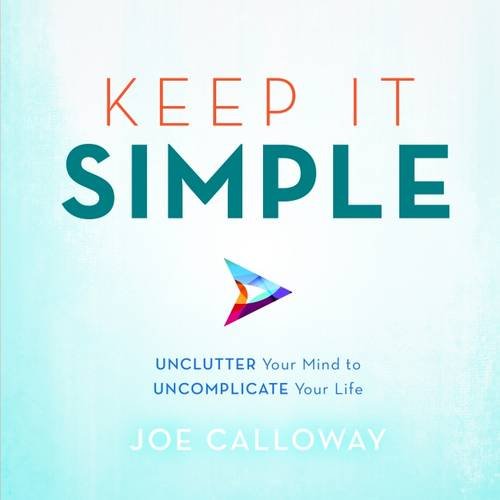
I recently reached out to Joe to check in and to say hello. Just a day after our email exchange, a package arrived at my door. I was excited to find a sweet letter and his latest book, Keep It Simple: Unclutter Your Mind to Uncomplicate Your Life.

Just as the title suggests, Keep It Simple is a short and simple book about simplifying your life. I highly recommend picking up a copy for yourself. I’m going to buy a few to give to friends who need to simplify things in their own lives, too. 

10 Joe Calloway Quotes That Will Inspire Simplicity

The following are ten quotes from Keep It Simple. Use these to start moving yourself in the right direction by simplifying your business, career, and life.  

"In order to get to simplicity, you have to have focus."

"Focus means clarity. Clarity means knowing what is most important."

"Getting focused is the path to simplicity, and simplicity is the path to success and fulfillment."

"Successful people have the ability to make the complicated simple."

"Our goal should always be to do that which creates value for our customers."

"As we simplify, we increase the likelihood of success."

"Complication freezes you into uncertainty and inaction."

"The quality of your life is largely determined by the quality of your relationships."

In addition to the inspiring ideas in his book, Joe recommends several thought-provoking exercises. Two of my favorites are the following.

"Create a “let-go-of list”. There is great wisdom and power in this idea, as you can’t accomplish the things you aspire to until you clear the space for them to happen."

"Think about every person in the past three days that has made a favorable impression on you. What was the common factor?"

I highly recommend picking up this little gem and putting it to work for yourself. Leave me a comment if you do, I'd love to hear your thoughts.

Too Many Ideas. Must Feed Family.

I'm a fan of Paul Jarvis. I've enjoyed his Sunday Dispatches email newsletter for sometime now. His message resonated with me this week (as it often does). In his email he wrote,

"The problem I’ve personally come up against lately is that thinking up these new ideas, new products and new models is a little addictive. At least to me. And now I realize that I’ve let my business get far too unfocused."

I am in the same boat. What's really challenging is working for myself. When I earned a steady paycheck, I could work on side projects whether they earned money or not. Most of them didn't, but that wasn't my intention. Now that I work for myself, I'm completely accountable for my time (and money).

I am absolutely dying to start a new podcast. I know what I want it to be, I know the guests I want to have on it, but it comes down to two things: time and money.

I figured out that my last podcast took me about four hours for each thirty-minute episode each week. That time included my guest research, lining up interviews, conducting interviews, editing the podcast, producing show notes, and promoting each episode. Aside from a few sponsors, the show didn't earn much money, so I had to kill it. I needed to focus on Futureforth, so I could be sure my family was being fed.

I have many new ideas for new meet-ups similar to my previous ones. I want to start a small, private mastermind group (message me if you're interested). I've been sitting on a conference idea for years. I had a new book idea, but realized it wouldn't land me consulting or speaking work, which means it wouldn't earn enough money. You get the idea.

Money, money, money...

Money, money, money... why does everything have to be about money? Because every minute of my day is on me. Because I have to feed my family. Because I want us to be able to afford the richest experiences (not things).

Did I solve this dilemma in this blog post? No. Maybe you have some ideas. I'll keep you posted on developments here.