Posts tagged public speaking
Tips to Transform Your Next Presentation

It's hard to believe it's been over ten years since I first delivered my Improve with Improv presentation, now known as The Master Communicator's Secret Weapon. I’m teaching presentation skills now, too.

Please join me as I cringe and share a younger Dave Delaney delivering this presentation at Hubspot’s Inbound Conference in 2015.

I'm going to share my notes with you to help you make your next presentation way better!

Last year was the first time I'd had an AV team unable to load my presentation due to hardware issues, so I delivered an opening keynote to 500 people with no slides. No problem. As a keynote speaker and master communicator (if I don't say so myself), it's essential to rehearse and thoroughly know your material. I emphasize this when I'm teaching my clients presentation skills, but I digress.

Let's get on with the show!

Cringe along as you learn from my mistakes and lessons.

00:14 - Pacing back and forth is a clear sign you're nervous. I was nervous because my audience was in the hundreds, and I had to deliver a brand-new presentation in just 12 minutes.

00:57 - Maybe too old or too old-fashioned, but I used to call the clicker a remote. I stopped doing this ages ago, but it's best to use the most common language so audiences understand what you're talking about.

01:25 - I said too many "umms"; this is also a sign of nervousness. However, I have never found that audiences judge me because of this. It's better to be human than slick. Still, fewer umms are preferred.

01:56 - I still use the shocked woman image in the latest version as an ode to my original presentation version.

02:39 - The stiff drink slide has been replaced in different versions of this presentation; for example, I delivered it at the Alabama Counseling Association's annual conference and felt that alcohol might be frowned upon. Know your audience. Fun fact: I'm over five years sober.

03:08 - If you plan to interact with the audience by asking a question for a show of hands, don't ask multiple questions at once, as I did. Their arms will get tired!

03:45 - Mentioning my improv training at The Second City in Toronto, performing in London, and my troupe in Galway, Ireland, all helped to validate me. I used to struggle with self-doubt, and such humblebrags helped convince me that I belonged on the stage.

03:59 - I changed "key things" to "core concepts" because it sounds better and it's more important than simply things. I also changed "acceptance" to "lead with acceptance."

04:18 - I still use the chicken slide to talk about acceptance as I cluck around the stage (or on your Zoom meeting), but now I ask the audience to give me their best chicken impersonations, and it's a laugh riot. Plus, they learn firsthand about acceptance by accepting my request. Shout out to this fun audience at Rocky Mountain Total Rewards Association.

04:57 - I mentioned "Yes, and" and later changed this to "Nice, and" to fit into my Nice Method framework. Plus, we can't accept every idea at work, but we can use "Nice, and..." to empower our colleagues. Message me and I will explain this to you and give you some examples.

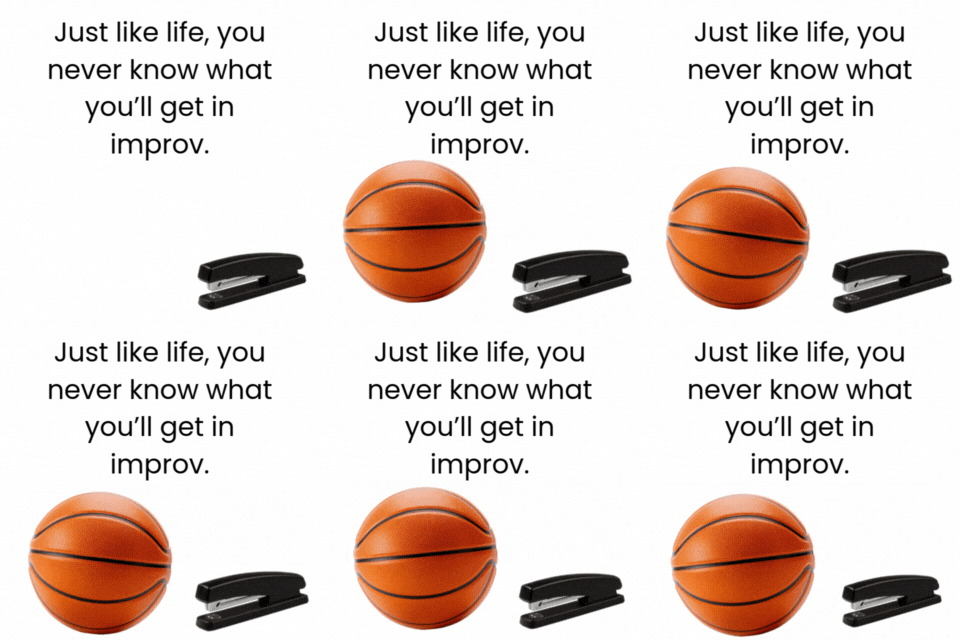
06:13 - I asked the audience at Inbound to give me an object, but I didn't mean literally. I felt bad as a woman in the front row eagerly jumped up to give me her notebook. I should have asked her for a fictitious object in hindsight, but I accepted the first one I heard from a gentleman in the back who yelled, "basketball!" Her eagerness was commendable, and I still feel bad for leaving her out. Sorry, nice lady.

06:24 - My improvised basketball dribbling mishap was fun in retrospect. Because I usually deliver this presentation for businesses and corporate events, I now ask for a random object you find in an office. Want to know a secret? It's always a stapler! Weird, right?

07:03 - My L.I.S.T.E.N. active listening acronym slide was designed terribly (by me). When my friends at Ethos3 redesigned my presentation, it was a game-changer. Hire professionals to create your slides. I highly recommend Ethos3; tell them Dave sent you.

07:52 - My wife would still agree that I talk too much, but we now know why, and I'm working on it. :)

09:30 - I mentioned using the bathroom as an excuse to escape a boring networking moment. It got zero laughs, and I haven't said it since. I learned this by rewatching the video countless times to review my performance. Bring a friend to record your presentation and review it. Bonus points if you watch it with no sound, then listen to it. You'll see and hear all sorts of areas for improvement.

10:03 - I rehearsed Improve with Improv countless times before speaking at Inbound, but I was concerned I might go long and only had twelve minutes. The Master Communicator's Secret Weapon runs 45-60 minutes and includes an optional breakout improv workshop. Because I noticed I only had two minutes left, I started speeding up and unintentionally added "right" and "ya know" after many sentences as filler words. I am anal about finishing my presentations on time out of respect for the conference planner, director, audience, and the next speaker starting after me. Going long can throw the whole conference off, and I never want to be that guy.

10:10 - When speaking about not fearing failure, I mentioned a jazz band example and then added Henry Rollins from Black Flag. These references were really for me because I wanted to meet other old punk fans at the conference. Still, I was there for the audience and have adjusted the presentation since to discuss how innovation occurs when we overcome our fear of failure. Did you know Nintendo started as a card game, and Sony made rice cookers?

11:12 - I removed the Slides. Advancing. On. Their. Own. I thought the visual gag would get laughs, but it fell flat. Kill your darlings and cut what doesn't work.

12:23 - After writing the script for Improve with Improv, I self-published it as a mini-ebook illustrated by my friend Daniele Rossi, and I offered it to the audience as a free download. Ten years later, I use a QR code for my audiences to receive a summary cheat sheet, an ebook, or other resources. I include a URL and my email in case of technical issues. Use this link and grab a free copy while you're here.

12:34 - At the close of my presentation, I invited folks to reach out on Twitter. Now, I wouldn't recommend X to a soul. Times sure have changed since 2015.

ONE LAST THING

One last big lesson I've learned over my nearly twenty years as a professional speaker is that we must sell to the problem and not the solution. More teams are seeking ways to overcome the fear of failure, improve listening skills, and become accepting leaders. They aren't searching for improv, and it's my job to reveal how the core concepts from improv are what make it the master communicator's secret weapon. Please feel free to reach out, and I'll tell you more.

I hope this helps you. I found it cringeworthy to re-watch and take notes on these, but I hope you find them helpful in improving your future presentations. Need help with your communication skills? I know a guy.

Become a Confident Speaker with a Public Speaking Coach Who Gets It

If you’ve ever searched “public speaking coach near me” or wondered whether working with a public speaking coach is actually worth it, you’re not alone. Public speaking remains one of the most common professional fears, yet it’s also one of the most powerful career and business accelerators when done well.

Whether you’re a leader preparing for high-stakes presentations, an entrepreneur pitching ideas, or a professional who wants to speak like a leader, coaching for presentation skills can change not just how you speak, but how you’re perceived.

As a Nashville public speaking coach, I work with adults, executives, and teams who want practical, human-centered coaching that builds confidence without forcing them to become someone they’re not.

There’s a reason why Google trusted me to speak on their behalf for over five years and why I’m booked as a keynote speaker.

Is a Public Speaking Coach Worth It?

Dave Delaney is a Public Speaking Coach in Nashville

This is one of the most common questions people ask, right alongside searches like “public speaking coach” or “best public speaking coaches.” The short answer: yes, when the coaching is tailored, practical, and rooted in real-world communication with your goals stated from the start.

A speech coach doesn’t just help you memorize lines or perfect slide design. The right coach helps you:

  • Clarify your message

  • Weave in humor and storytelling to deliver memorable speeches.

  • Reduce anxiety and self-doubt

  • Build authentic confidence

  • Improve delivery, structure, and presence

  • Plan to set and reach your presentation goals

  • Communicate with impact in meetings, presentations, and on stage

That’s why many professionals actively search for the best public speaking coaches, not just generic courses.

Working With a Public Speaking Coach: What to Expect

When people ask, “What happens when you work with a public speaking coach?” they’re usually worried about being judged or pushed into uncomfortable performance tactics.

My approach to public speaking, private coaching, or group workshops is different, and my testimonials are testament to what you’ll receive.

I focus on:

  • Your goals, not someone else’s speaking style

  • Real presentations you actually need to deliver

  • Practical tools you can reuse again and again

  • Building confidence through clarity, not pressure

This is coaching for people who want to become a confident speaker, not a scripted performer.

Public Speaking Coach Dave Delaney

I’ve spent decades helping professionals improve how they communicate, connect, and lead. As a business speaking coach and executive public speaking coach, I work with clients across industries who want to:

  • Lead meetings with authority

  • Present ideas clearly and persuasively

  • Speak confidently without “faking it”

  • Strengthen leadership presence

If you’re searching for a public speaking coach in Nashville or Nashville public speaking training that feels grounded and human, you’ve got the right person.

Public Speaking Coach Training, Certification, and Courses

People often ask about public speaking coach certification or whether a confident public speaking course is enough. Courses can be helpful, especially for foundational skills, but coaching offers something different.

With public speaking coach training, you get:

  • Personalized feedback

  • Real-time coaching on your actual talks

  • Online and offline marketing and promotional strategies

  • Accountability and practice

  • Support tailored to your experience level

That’s why many clients choose public speaking private coaching over one-size-fits-all programs.

Online Coaching and “Near Me” Searches

Thanks to virtual sessions, working with a speaking coach online can be just as effective as in-person coaching. Whether you’re searching for “best public speaking coaches near me” or “public speaking coach near me,” location no longer limits access to high-quality coaching.

That said, if you’re specifically looking for a Nashville, Tennessee public speaking coach, I offer both local and remote options. In person is always preferred, but improving your virtual presentation skills is equally important these days.

Who This Is For

My coaching is designed for:

  • Adults who want an honest presentation coach who gets results

  • Leaders seeking executive-level communication skills

  • Professionals looking for coaching for presentation skills

  • Entrepreneurs and speakers preparing for key moments

  • Anyone ready to become a confident speaker

This is not about chasing viral stage tricks or icky marketing gimmicks. It’s about sustainable confidence and clear communication. Public speaking is a skill people actively invest in because it pays dividends across careers, leadership, and life.

Ready to Speak Like a Leader?

If you’re considering working with a public speaking coach and want support that’s practical, respectful, and results-driven, I’d love to help.

Whether your goal is to lead with confidence, deliver better presentations, or finally feel at ease when you speak, the right coaching can unlock skills you already have.

I love to help professionals become confident speakers through clarity, connection, and communication that actually works, and as always, a ‘good fit’ coaching call is complimentary, so what’s stopping you?

BOOK A GOOD FIT COACHING CALL
What Meeting Planners and Professional Development Leaders are Seeking in 2026

If you’re planning events for 2026, I know your challenge isn’t finding speakers. It’s finding speakers who actually help your audience work better when they return to work.

I spend a lot of time talking with meeting planners, conference chairs, and leadership teams. The same themes keep coming up: hybrid fatigue, disengagement, fear around change, uncertainty about AI, and concern about retention. What leaders want now isn’t hype or inspiration for inspiration’s sake. They want clarity, confidence, and practical tools their people will actually use.

That’s where I focus my work.

Everything I deliver on stage centers on the human side of modern leadership. Not because it’s trendy, but because it’s foundational. When communication breaks down, culture weakens. When culture weakens, innovation slows. And when people don’t feel connected, they leave.

A helpful reframe for meeting planners

Here’s a question I encourage planners to ask when evaluating speakers:

“What will our people do differently because of this session?”

The best events I’ve been part of aren’t remembered because the speaker was charismatic or confident, but because attendees:

  • used the language from the keynote later that same day

  • applied the techniques in meetings and hallway conversations

  • referenced the ideas weeks later during change initiatives

That’s why my presentations are designed to be immediately usable, not just inspiring.

Why bringing people together still matters (especially now)

One of the biggest leadership blind spots I see today is underestimating the value of intentional in-person connection.

Hybrid work is here to stay, but when teams don’t really know each other, something important erodes:

  • affinity for the brand

  • trust between colleagues

  • willingness to take risks or share ideas

When a competitor comes along with higher pay or better benefits, disconnected employees don’t hesitate to leave.

On the other hand, when leaders bring people together with a purpose for events like off-sites, retreats, and internal conferences, something different happens. Energy shifts. Conversations become more human. Ideas flow more freely. Relationships deepen naturally.

For planners, this means your event isn’t “just another meeting.” It becomes a culture reset.

The foundation: The Master Communicator’s Secret Weapon

My signature keynote, The Master Communicator’s Secret Weapon, is built around three leadership behaviors that show up in every healthy organization I’ve worked with:

  • Lead with acceptance to create psychological safety

  • Listen with intent instead of listening to reply

  • Overcome the fear of failure so teams can adapt faster

Here’s why this matters for your audience.

Teams that feel safe speak up sooner. Leaders who listen better make better decisions. Organizations that reduce fear move faster through change, including AI adoption and innovation.

For meeting planners, this keynote works especially well when:

  • your audience includes leaders navigating change

  • you want a shared language that attendees can use

  • you’re opening or closing a conference and want momentum to carry forward

Culture and engagement in hybrid worlds

One thing I tell leaders often is this: culture doesn’t disappear in hybrid environments, but it does become accidental unless you design for it.

In my keynotes, I help audiences rethink engagement as something leaders actively practice, not something HR owns. Simple communication shifts—how leaders listen, respond, and invite participation—have an outsized impact on morale and retention.

For conferences, this topic pairs well with:

  • leadership development tracks

  • HR, talent, or DEI programming

  • internal events focused on retention and engagement

The goal isn’t to force people back into offices. It’s to help leaders create moments of connection that actually matter.

Innovation, resilience, and the human side of AI

AI is changing how we work, but it doesn’t remove the human equation. In fact, it magnifies it.

When leaders introduce new tools without trust or psychological safety, teams often respond with fear or quiet resistance. When leaders focus first on communication, curiosity, and permission to experiment, adoption accelerates.

For planners, this is where human-centered leadership content becomes a bridge between technical sessions and real-world application. It helps audiences leave not just informed, but ready.

How my three keynotes support modern events

I structure my work so planners can mix and match based on audience needs:

Together, these talks support connection, inclusion, and adaptability without overwhelming your agenda.

What tends to stick after the event

The feedback I hear most often isn’t about slides or stories. It’s things like:

  • “Our team started using the tools on each other immediately.”

  • “We should’ve scheduled this earlier in the conference.”

  • “This changed how our leaders listen.”

That’s the outcome I aim for.

I partner with organizations that care about building cultures people want to stay part of. My role isn’t to steal the spotlight. It’s to help your event create a lasting impact.

If you’re designing a conference or internal gathering and want your audience to leave clearer, more connected, and better equipped for what’s next, that’s a conversation I’m always happy to have.

Communication isn’t a soft skill. It’s a superpower, let me show you what I mean.

Lessons on Communication from Six Years Speaking for Google

For six years, I traveled across the U.S. and Canada as a speaker and facilitator on behalf of Google, visiting bustling cities and quiet towns, delivering workshops to audiences of every size. From small community libraries to packed convention halls, I had one mission: to help people grow through better communication — with technology, with each other, and within their own organizations.

But while my audiences came to learn tools and tactics, I came away with something even more lasting: countless lessons on what truly makes for great communication from the stage, in workshops, and in every human interaction.

Know your stuff — and plan for tech to fail.

No matter how flawless your slides are or how slick your video is, technology fails (see video below). Communication starts with confidence, so I never relied on internet connections. I downloaded every video, embedded them directly, and always tested AV well before showtime. I walked around the room to ensure the slides were legible from the back, checked where sunlight might blind the screen, and especially verified that my clicker worked from every angle. Great communication is part preparation, part flexibility, and the ability to improvise when need be (shh, that's the secret).

Treat every audience like friends.

Whether I was in NYC or a small town in Arizona, I always made it a point to connect. Before arriving, I’d set up Google Alerts for the local area to find good news — a high school baseball victory, an upcoming chili cookoff, a town anniversary. I’d mention local favorites, often after eating there myself. People lit up. They weren’t just attending a presentation; they felt seen because authentic communication is about making people feel understood and valued.

Keep it clear and inclusive.

Most of the people who came to my sessions weren’t experts. They were eager to learn. That meant I stayed grounded, avoided jargon and made sure no one felt left behind. I encouraged every question, stayed late for one-on-one help, and genuinely welcomed curiosity. Because great communication isn’t about showing off what you know; it’s about making your audience feel smart, supported, and capable.

Fill the front rows (literally).

One of my favorite little tricks: I traveled with big note cards that read “RESERVED FOR VOLUNTEERS.” I’d ask hosts if we could place them on the back rows and seat the audience from the front. When people sit close, laughter spreads, networking happens, and event photos look amazing, which matters for future event promotion. It’s a small step that makes a huge difference in the energy of the room. And all of that ultimately improves communication between the speaker and the audience.

Know your craft. Care about people. Never shut down curiosity. Because technology glitches, audiences remember how you made them feel, and every question is a door to deeper trust and impact.

Available for what’s next.

Today, I continue helping teams and organizations level up their communication — whether it’s through keynote presentations, in-house training, or train-the-trainer programs. If your team or event needs someone who has learned these lessons firsthand, I’d love to explore the possibility of working together.

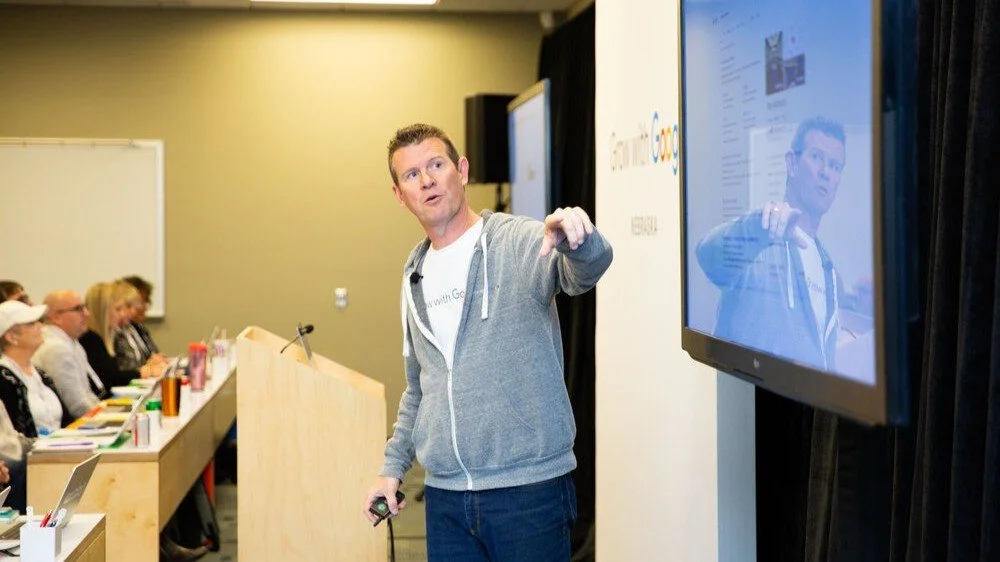
Speaking for Google.

As my friend and leader of the Grow with Google program, Anastasia Kudrez, kindly wrote in her LinkedIn recommendation:

"If you have an opportunity to work together, it will be worth it. He knows his stuff..."

5 Must Hear Podcasts about Presentations. Are you subscribed?

As a keynote speaker, I am always working to improve my craft and my business. I find plugging peers into my ears via podcasts is a fantastic way to learn new methodologies of the craft of public speaking.

Even if you are not striving to grow a speaking business, you must admit that you can always improve how you communicate. Perhaps you will have a presentation to deliver to your board, an all-hands meeting for your staff, a pitch to investors, a wedding toast or eulogy. You can always improve how you communicate by learning from master communicators.

5 Must Subscribe Podcasts to Improve Your Presentation Skills

Steal the Show podcast with Michael Port

Steal the Show with Michael Port

Every day, there are moments when you must persuade, inform, and motivate others effectively. Each of these moments requires you in some way, to play a role to heighten the impact of your words, and manage your emotions and nerves. Every interaction is a performance whether you’re speaking up in a meeting, pitching a client, or walking into a job interview. Michael’s great voice and inspiring delivery will keep you hooked from the very first episode. Web | Apple Podcasts

Standing Ovation with Jay Baer

Standing Ovation with Jay Baer

Standing Ovation, hosted by keynote speaker and emcee Jay Baer is where the very best public speakers reveal the secrets behind their greatest successes. In each episode, listeners hear a legendary on-stage story from a world-class speaker, and then hear Jay and his guest dissect and discuss that story. How are the best on-stage stories (some of them decades old) found, written, polished, and changed? When do they work best? When do they bomb? Web | Apple Podcasts

Speaker Lab.jpg

The Speaker Lab with Grant Baldwin

Grant Baldwin from The Speaker Lab podcast shares speaking business tactics, tips, and strategies from his own experience, case studies, and interviewing the experts. Whether you're just getting started trying to get your first booking or you're a veteran speaker looking to build and grow your business, this is for you. Web | Apple Podcasts

The Freenoter with Tamsen and Tom Webster

The Freenoter Podcast with Tamsen and Tom Webster

Introducing The Freenoter! There are lots of resources out there on how to become a paid speaker or keynoter, but what if you speak to build your business, as a FREEnoter? Each week, join Tamsen and Tom Webster as they cover all the angles of how to profit from speaking for free. If you are looking to grow your business from the stage--without "selling from the stage," this is the show for you. We will cover EVERY aspect of building your business through speaking, and even share a different craft cocktail recipe every week, just because. Web | Apple Podcasts

Good One with Jesse David Fox

Screen Shot 2020-01-28 at 9.45.32 AM.png

(NSFW) Each week, a comedian will play one of their jokes and then break it down with Vulture.com Senior Editor Jesse David Fox. The is a podcast about - well - jokes, and the people who tell them. Web | Apple Podcasts


Each of these stellar shows will teach you the ins and outs of the speaking business. You will learn countless performance techniques and business development skills that will help you next time you are delivering a presentation or a speech.

Let me know what you think. I would love to hear from you.

Public Speaking Tips You Haven't Heard Before
Photo from Flickr by the awesome Dave Barger. Dave Delaney speaking at BarCamp Nashville in 2008.

Photo from Flickr by the awesome Dave Barger. Dave Delaney speaking at BarCamp Nashville in 2008.

Do a Google search for “public speaking tips” and you will find 313,000,000 results. I hope I can share a few tips here that you may not be familiar with, and this also might help.

This post idea came from my recent search for a specific image on Flickr. That’s when I happened upon this photo by the late, great Dave Barger. I hadn’t seen the photo in years. I was surprised to note that the photo of me on stage is from 2008. Time flies!

I’ve been presenting to audiences for decades.

Dave’s photo made me reflect on the lessons I have learned. I’ve presented to audiences of thousands and tens, so I decided to share a few tips I hope you find useful.

Whether you are just getting started as a speaker or you’ve been doing this a long time, I hope these lessons help you.

Public Speaking Tips You Haven’t Heard Before

I always ask conference organizers the following questions: “What does success look like in the minds of your audience?” and “Who are the most popular speakers you have had? What made them stand out?” This information helps me craft my presentation with the audience in mind.

Give the audience a way to get in touch with you after your presentation. Include a slide with your URL/email/phone number/social. Bonus points for leaving them something of value like a digital download of your presentation or cheat sheet with takeaways from your talk. I use a text-to-download service for this*. Anyone who downloads the PDF also gets subscribed to my email newsletter. This is noted before they download the document, so they can choose not to if they prefer.

* If you use such a service and you’re speaking in a different country be sure this will still work.

Always talk to the AV team before your talk. They are there to support you (not work for you). Do a mic and presentation test to be sure everything looks and works the way you expect. Test it from the stage not the AV booth. Don’t rely on a solid Wi-Fi connection. Embed videos if you plan to include them.

Avoid using other peoples' equipment whenever possible. If you must use their equipment, test it ahead of time. For example, the range of the clicker may not be wide enough for you to work the entire stage or move around the floor. 

Get as much information as possible about the audience. The more you know, the better you can make your presentation. 

Research the city. I search the city in Google News to find topics I should mention and perhaps avoid. 

Eat locally. I try to plug a local restaurant or coffee shop I discovered before the event. Audiences appreciate you spending your money locally instead of hiding in your hotel room or going to a chain restaurant. 

Be respectful to the organizers, audience, and other speakers by staying on time. I just bought a small countdown timer to pack along with my gear. Other speakers I know use their watches, iPads, and apps. Keynote and Powerpoint also include a timer if you are presenting with you computer in view.


I hope these tips will serve you well. I’ve written more about how I can help you in this post.

Catching Up with Marcus Whitney

This coffee catch up was way overdue. I love that Marcus Whitney recorded it and shared it with his friends, fans, and followers. I wanted to do the same here because there is so much great content within. Marcus is a good soul, be sure to check him out.

What we talk about:

  • public speaking

  • improving workplace communication

  • book writing

  • LinkedIn best practices

  • entrepreneurship

  • social networking

  • social media

  • podcasting

Do you have questions or comments? Drop them down below and I’ll do my best to help you.

How to Deliver a Killer Presentation: The Spacetime Symphony of Gravitational Waves
The Milky Way

Have you ever looked up at the sky at night and wondered about the Milky Way? Do you ever consider your actions and the effects they have on the universe? Do you want to become a better public speaker? Are you wondering what these have in common? Have I opened this post with too many questions?

I had the great pleasure of spending my birthday at TEDXNashville this year. Heather and I agreed that our favorite speaker was astrophysicist, Dr. Kelly Holley-Bockelmann. We decided "The Spacetime Symphony of Gravitational Waves" was our favorite because of several reasons. 

Why we chose Dr. Kelly Holley-Bockelmann's presentation as the best TEDX Nashville for 2016 

There were many amazing presentations, but The Spacetime Symphony of Gravitational Waves stood out for som

  • She dumbed down an extremely complex topic so the audience would understand. Even I understood!
  • Her passion for the topic was contagious. 
  • Humor was used throughout the presentation that kept us laughing. 
  • She reflected on something we all recognize, staring up to the Milky Way. I loved that she started with this and returned to it again at the end. 
  • The presentation was interactive as the audience rose to take part in The Gravitational Wave Dance.
  • She was the best-dressed presenter. Her dress was a memorable part of the presentation. 
  • She left us with a profound thought that we must consider each day. 

As a public speaker, I always watch presenters with the intention of learning new ideas to deliver more impactful talks. This presentation was definitely one that will stick with me. 

Even if you have no interest in understanding supermassive black holes, spacetime, or gravitational waves, you must watch this presentation.

Get ready to learn why your choices matter and how they will be written into the universe. 

If you want to learn more about delivering a killer presentation, pick up a copy of Talk Like TED: The 9 Public-Speaking Secrets of the World's Top Minds by Carmine Gallo.

Milky Way photo by James Wheeler