
Flipping the Golden Rule: Why Self-Respect Must Come First
Most of us learned the Golden Rule as children: treat others the way you want to be treated. It's a simple, powerful idea, and I believe in it completely. Then I got diagnosed with ADHD at fifty and started paying attention to how I actually talked to myself.
What I found was uncomfortable. I was extending patience, grace, and compassion to people around me while running a relentless internal monologue of criticism toward myself. I was following the Golden Rule in every direction except inward.
That realization became the foundation of the Root Down Framework and the reason I believe the Golden Rule needs to be flipped as I explained in my TEDx Talk.
Can You Truly Respect Others Without First Respecting Yourself?
The Golden Rule assumes you already have a healthy baseline of self-regard. For many people, especially those navigating undiagnosed ADHD, anxiety, or chronic self-doubt, that baseline doesn't exist. You cannot draw water from an empty well.
Sustainable empathy, authentic leadership, and genuine connection all require that you first build the internal resource you're trying to give away: respect.
The Root Down Framework: Why "Respect Yourself" Is the Bridge
The Root Down Framework has three pillars: Know Yourself, Respect Yourself, and Connect Yourself. Respect sits in the middle deliberately. You can spend years learning who you are, your strengths, your neurotype, your patterns, but without self-respect, that knowledge stays theoretical. And without self-respect, your ability to connect with others stays surface-level.
You can discover your superpower here.
Here's what self-respect actually looks like in practice:
Self-Acceptance: Owning Your Whole Self
Self-respect starts with accepting your complete identity, not the edited version you think is more palatable. For people with ADHD or other neurodivergence, this often means releasing the story that your brain is broken and replacing it with the truth: you are differently wired, not defectively wired. Your quirks aren't bugs. In many cases, they're the source of your most distinctive strengths.
Boundary Setting: Signaling That Your Well-Being Has Value
Boundaries are not walls; they're communications. When you protect your time, energy, and attention, you send a message to yourself and others that your well-being matters. People who struggle with self-respect often over-commit, under-charge, and absorb other people's problems as their own. Setting a boundary is an act of self-respect and, counterintuitively, it often deepens relationships rather than damaging them.
Cognitive Reframing: Catching the Inner Critic
The inner critic is loud, fast, and convincing. Cognitive reframing is the practice of interrupting that voice and replacing its verdict with a more objective one. Not toxic positivity, just accuracy. Instead of "I always ruin everything," the reframe is "I made an error. What can I learn from this?" It's a small shift with compounding returns.
Mindfulness: The Practice That Makes Self-Respect Possible
You cannot reframe a thought you haven't noticed. Mindfulness is the practice of present-moment awareness, which is what creates the gap between a trigger and your reaction to it. It's in that gap where self-respect lives.
Next to therapy, mindfulness and meditation are the most consistently effective tools I've encountered for building self-respect. You don't need an hour a day or a meditation retreat (although that’s great). You need a technique you'll actually use.
Box Breathing: A Tool You Can Use Right Now
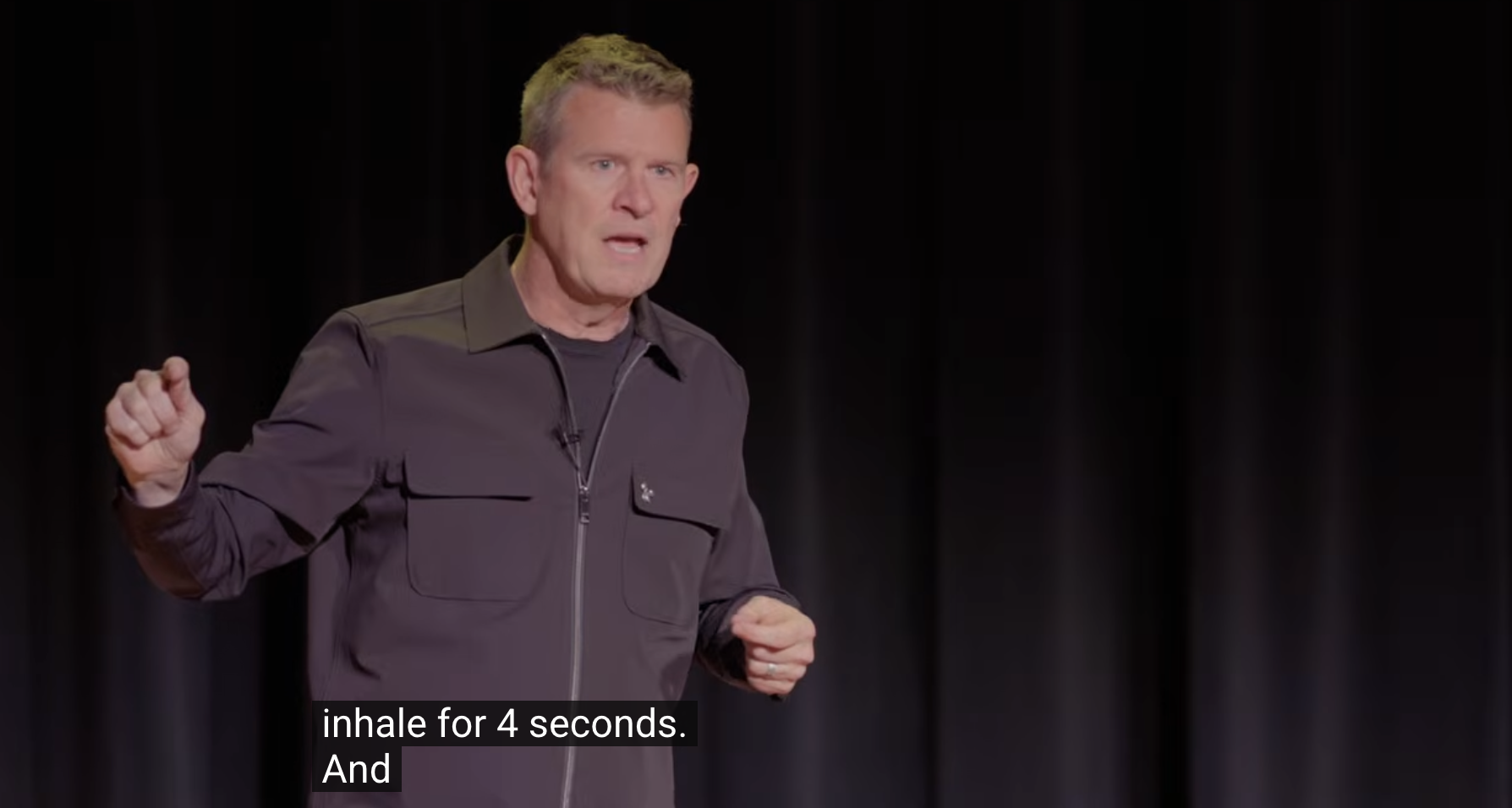
Box Breathing is a regulation technique used by military personnel, athletes, and high-performance leaders. It interrupts the stress response and restores clarity in under two minutes.
How to do Box Breathing (watch the video):
Inhale slowly through your nose for 4 seconds
Hold your breath for 4 seconds
Exhale completely through your mouth for 4 seconds
Hold your lungs empty for 4 seconds
Repeat 3–4 cycles as needed
That's it. Four seconds times four. It works because it activates the parasympathetic nervous system, the biological off-switch for the fight-or-flight response.
Mindless vs. Mindful Self-Treatment
Self-respect is easiest to observe in high-stress moments. Here's what the difference looks like in practice:
| Trigger | Mindless Response | Mindful Response |
|---|---|---|
| Making a mistake at work | "I'm so stupid. I always ruin everything." | "I made an error. What can I learn and how do I correct it?" |
| Exhaustion at the end of the week | Pushing through fatigue to avoid disappointing others | Honoring the body's need for rest — declining an invitation without guilt |
| Watching others in a life stage you've passed | Spiraling into regret and loss | Reframing toward gratitude for having lived that season |
| Receiving criticism | Immediate shame spiral or defensive anger | Pausing, evaluating what's useful, releasing the rest |
Frequently Asked Questions
What is the Root Down Framework?
The Root Down Framework is a three-step model for self-awareness and connection developed by speaker Dave Delaney. Its three pillars — Know Yourself, Respect Yourself, and Connect Yourself — provide a practical sequence for building authentic confidence and improving both personal and professional relationships. The framework was introduced in Dave's TEDx talk about ADHD in May 2026.
Can you genuinely follow the Golden Rule without self-respect?
Not sustainably. The Golden Rule — treating others as you wish to be treated — presupposes that you treat yourself with basic care and regard. Without that foundation, what passes for generosity toward others is often depletion. Self-respect is not selfishness; it is the prerequisite for durable empathy.
How does self-respect affect leadership and team dynamics?
Leaders who lack self-respect tend to seek external validation, avoid necessary conflict, and model self-critical behavior that teams absorb. Leaders who practice self-respect set clearer expectations, recover from mistakes more quickly, and create psychological safety for others — because they've built it for themselves first.
Building the Foundation: A Note From Nashville
Flipping the Golden Rule doesn't make you selfish. It makes you sustainable. The people who show up most fully for others as leaders, colleagues, partners, and parents are the ones who've done the work of knowing and respecting themselves first.
As a keynote speaker and coach based in Nashville, Tennessee, I work with organizations across the country on exactly this: helping people and teams build the kind of self-awareness and connection that actually holds up under pressure. The Root Down Framework is the through-line in that work because it starts where every meaningful change starts — from the inside out.
Ready to bring this conversation to your team or event? Check my availability.